
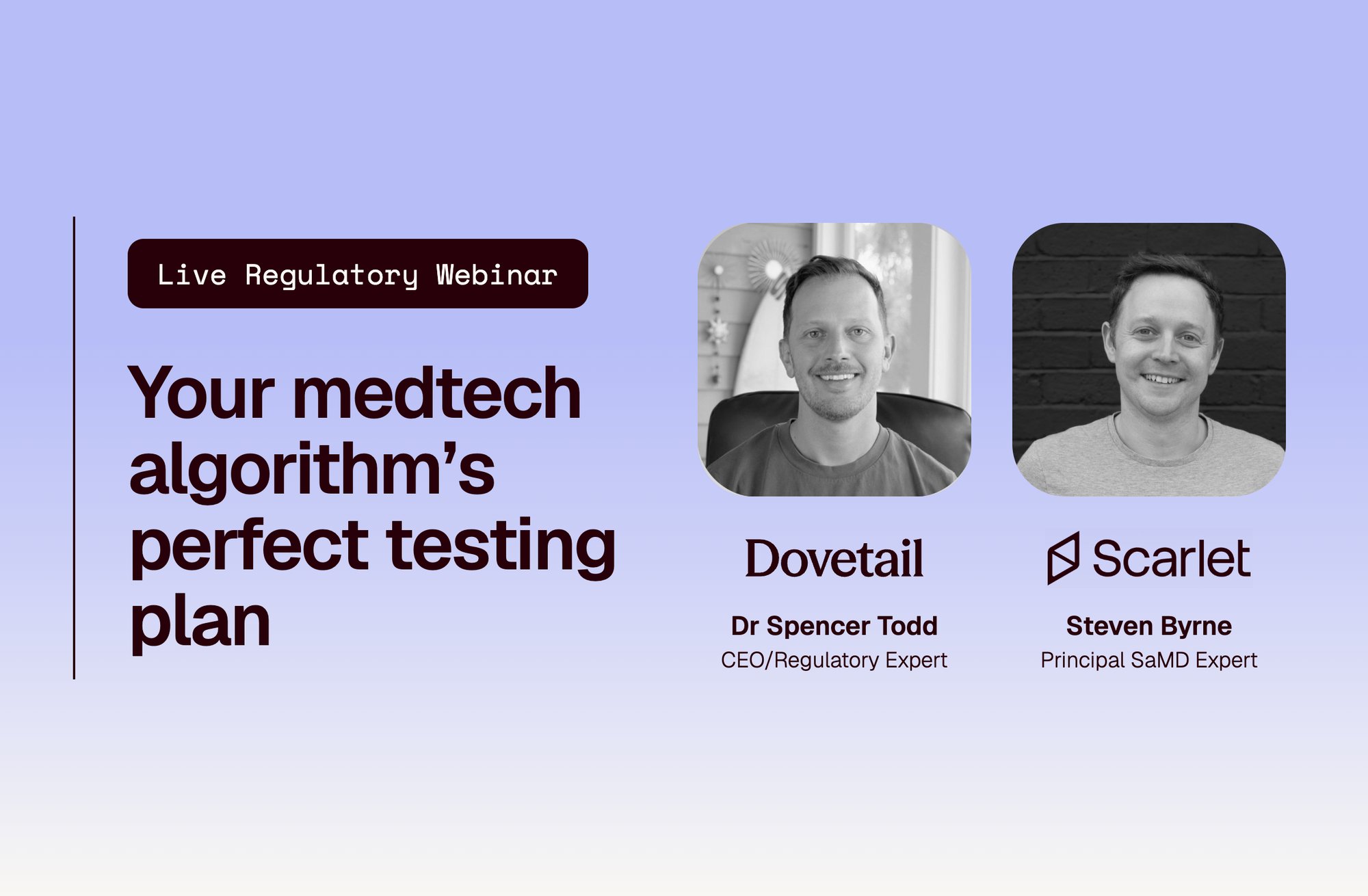
A passing test pipeline proves your code runs, not that your medical software is safe or clinically effective. In this webinar, Dovetail CEO Spencer Todd talks with Steven Byrne, Principal SaMD Expert at notified body Scarlet, about what reviewers actually look for in a Software as a Medical Device (SaMD) testing plan.
Watch the webinar
Prefer to read or search for a specific answer? Read the full transcript below.
Quick takeaways for your SaMD testing plan
1. Separate verification from validation.
Unit, integration, and CI pipeline tests show you built your software to spec under IEC 62304, even in simulated environments. Validation tests the deployed product in a production-like environment across four areas Scarlet checks in a SaMD submission. Those are functional testing against product requirements, clinical evidence, independent security testing like penetration tests, and usability engineering. Strong clinical evidence will not make up for missing usability or cybersecurity testing.
2. Let your clinical claims set the evidence bar.
Clinical evaluation covers technical performance, valid clinical association (often backed by literature for established pathways like PPG-based oxygen saturation), and clinical performance for your intended purpose and user base. Start from your intended purpose and clinical claims, check what data you already have, and then decide whether retrospective data, post-market data from another market, an independent dataset, or a prospective study fits. Clinical evaluation is the most painful piece to get wrong late, so use early structured dialogue with your notified body to clarify expectations before you waste time and money.
3. Make traceability easy for reviewers to inspect.
First-time medtech teams often have the tests but miss the links between them. Separate narrative documents like your risk management and software development plans from discrete tabular records such as hazards, software requirements, design items, and test cases, and give every item a unique ID. A reviewer should be able to pick a product requirement and trace it straight through software requirements, architecture, and unit, integration, and functional tests.
4. Prove AI risk controls work in real clinical workflows.
Machine learning and large language models introduce misclassification, hallucinations, and non-deterministic outputs, so treat the model itself as a hazard. Set clear sensitivity and specificity benchmarks, validate inputs and outputs, and run usability testing to prove a clinician will spot an error and override it instead of accepting the output through automation bias. Be transparent about dataset biases or demographic gaps, justify why your device is safe to release now, and pair that with post-market clinical follow-up to close the gap over time.
5. Plan FDA and EU market order before locking your testing program.
Software verification activities look similar across the US and Europe, even when FDA basic and enhanced documentation sets ask you to expose less paperwork than EU MDR. Clinical validation requirements can diverge sharply, so your regulatory strategy should decide which market comes first, such as entering the US via a predicate device to build data for Europe or starting in Europe or the UK. Follow industry-standard practices across software, clinical, and cybersecurity, then adapt the data to each jurisdiction's submission format.
6. Keep traceability alive after version 1.0, especially with third-party models.
Passing initial review and slipping back into informal releases creates audit findings a year later, because even non-significant bug fixes require change categorization in your QMS along with updated design control records and traceability matrices between versions. For significant changes, Scarlet looks for the scope of the change and a clear rationale for your regression testing. If your product relies on third-party models like Gemini, Claude, or ChatGPT, those models deprecate in weeks or months, so build fast retesting and revalidation into your release process. Predetermined change control plans (PCCPs) can help, though Scarlet's EU PCCP work is still a pilot and overlaps with, rather than replaces, wider post-market clinical follow-up.
Before you submit, walk a product requirement through your own records from software requirements and architecture to risk controls and test evidence. If a requirement hangs without an obvious test proving it is effective, you just found a gap before your reviewer did.
Want a senior regulatory team to review your testing plan or map your FDA, EU, UK, or Health Canada pathway? Book a discovery call and we will tell you honestly whether we can help, and what the shortest path to clearance looks like.
Full webinar transcript
Below is the full transcript of the original recording. Timestamps may differ from the edited replay.
Spencer Todd (00:01)
Okay. thanks everybody for joining today. my name is Spencer. I am the CEO of Dovetail. we are your partner for market access for the US, Health Canada, EU, and the UK. so really excited to to to run this webinar today on your med tech's med tech algorithms perfect testing plan.
we've been working with Scarlet for a little while now, so it's gonna be great to have Steven here to to chat on their behalf and give everybody some insight into
into creating the perfect testing plan ahead of your notified body submission. So I'll introduce Steven here. So Steven Byrne is the principal software's medical device expert at Scarlet. he creates and delivers a lot of technical content. You've probably seen some of his blog posts, things like that, and then advises on software and AI medical devices.
At Scarlett, they he helps essentially manufacturers navigate the technical regulatory complexity of building safe and effective medical software. Before Scarlet, Steven was developing medical device software, SAMD, SIMD, as a medical device products. he has a bachelor's in computer science from University of College Dublin, Master's in Software Engineering from NUI Maynooth, and a PhD in electrical engineering from Queen's University Belfast. So excited to welcome Stephen here today.
Steven Byrne (01:34)
Hi Spencer, good to be here. Thanks for having me.
Spencer Todd (01:37)
Course. Thanks for joining Steven. Cool. so I thought that we could just start and just chat a little bit about Scarlet itself and and you can kind of give kind of a background as well. Hopefully I touched on everything in our my brief intro, but maybe you can just give a quick background on who Scarlet is, what kind of devices you all review, maybe what makes you a little bit different as a notify body, maybe compared to other ones as well.
Steven Byrne (02:02)
Yeah, so we're a notified body, we specialize in software and AI devices. so at the moment it it's software as a medical device. AI is a medical device, but we do have goals to
quite soon hopefully be able to add hardware, active hardware or IVD software based based devices as well to that. And what makes us different really is, you know, if it give the origin story from Scarlet, we're born out of frustration really with the regulatory process. So like our two co-founders, they were at Babylon Health, they were creating software as a medical device. And although they were able to iterate quite quickly on the functionality of the product, they're able to re-verify and validate it and they're able to deploy it quite quickly. It was really that regulatory hoop for change requests that that
they that was their first site where they saw how broken that is for software. so they really set about then creating a notified body that was special specializing in software. And really what we try and do is is match our assessment process and our sort of skill set to software AI devices where we can, you know, hopefully help manufacturers iterate quickly and get to market and continue to push frequent updates so that they can constantly meet the needs of their their customers.
Spencer Todd (03:09)
Awesome. I think a lot of us can relate to that to those difficulties in the past. And now everything, pretty much everything is is either software based or has software in it, right? So that's really important
Steven Byrne (03:17)
Yeah, that's
Spencer Todd (03:19)
to be to be specialized there. So when you're thinking about how essentially
doing the conformity assessment process and engaging with clients or companies that are looking to use you all, when is typically the right stage to engage? 'Cause I know that we've had some engagements and we've done quite a few structured dialogues and things like that and I think it's been really helpful. But it's just kind of curious from your side when you think the best time it is for people to come to you and and start those engagements.
Steven Byrne (03:43)
Yeah, I think it's earlier than most people think. Like the yes, we're not going to be certifying your device until you've got all your documentation in place and your QMS in place. But there's a lot of upfront sort of planning activities that are really important to get right. and actually having a notified body's viewpoint on that or just
you know, a a a sounding board really is quite is quite beneficial. So like two in particular, like the device classification, especially under EU MDR, is like, have you got are you a class two A, you class two B? A lot of people try and avoid those two when their device needs to be. So having a sounding board there is quite important. And then also your clinical evaluation strategy, that's one that it's very important to get it right up front and having a structured dialogue with someone like ourselves on that topic. Make sure that you're on the right path before you
waste a lot of time and money on doing something that mightn't actually, you know, show that your your intended purpose has been met.
Spencer Todd (04:39)
Yeah. Yeah, I think that's that's
Very underrated for folks. I think we also say the same thing is like if you can engage, engage early because it's kind of like an expectation meets reality thing. And it's always good to if you can get a chance to to communicate with with who's gonna be reviewing or your your submission package or you know who's on the team supporting, it's always good to get like perspectives on that, right? Because there tends to be a lot of gray area for a lot of this stuff, right? So it's always good to know ahead of time if you can figure that out. So I guess like a couple more questions just on Scarlet, 'cause I think it's a good kind of
intro to this conversation on testing plans, right? Which so so when when people submit, what typically makes a smooth CE marking process, both from kind of the client side and I guess like what you expect to see, maybe what they'll expect from your team to make sure things kind of go smoothly once they kind of hit the submit button for the for the submission.
Steven Byrne (05:31)
Yeah, good question. I think there's two things I'd say there. One is from the manufacturer side, it's making sure they understand the importance of the regulatory and quality functions early on in that journey and they're not just trying to tack it on when the device has been built. because obviously, you know, if the earlier on you can you can consider these these items, the sooner you'll surface issues that you need to solve and you can then do it, you know, do those regulatory challenges in parallel to your development. and the other one then is is making sure that
we've got clear expectations on on both sides. And that's probably the thing that we see with the industry is really lacking is that, you know, as a notified body, we're not able to look at your documentation until you submit. We're not allowed be involved from a consulting pers consultancy perspective in the run up to that as well. So without proper communication, and if we only see your documentation for the first time, it could be you spent months creating things that actually we're not looking for and you're
you're short in areas where we we're really gonna have a deep look at. So yeah, what we try and do is in that pre submission phase is although we can't consult, is make sure that you're armed with, you know, how we interpret the regulations a lot. And also, you know, we make sure we have as much kind of dialogues within the con confounds of our our regulations that we can do. So that when that submission occurs, you know, a lot of the unknowns have been ironed out beforehand.
Spencer Todd (06:54)
Structured dialogue's very important.
Steven Byrne (06:56)
Yes.
Spencer Todd (06:57)
yeah, and I think I think you all do a a nice job too of kind of putting some formality around it 'cause it is it can be a somewhat informal process. So, you know, there's some some fairly like structured submission documentation that your your teams always put out for folks so that you're trying to capture as much of that data ahead of time to kind of just make sure that you didn't miss anything, which I think is really helpful.
all right, last thing. I know this was announced earlier this year, but we and we have some some US folks on the call, but just kind of curious how you all support people looking for US FDA clearance as well.
Steven Byrne (07:29)
Yeah, so yeah, we're very happy to be able to say that we're now accredited by the FDA to do the third party review for five ten K submissions. So that's really opened up a pathway for, you know, existing customers who are certified in Europe and want to expand into the US when also they'll have bring in new customers and also do sort of product codes as well that we can support in in the US. So yeah, like
We're we're getting that off the ground. We're doing our first ones now and it'll be it'll be quite interesting to see how much that gets adopted over the the coming months as well.
Spencer Todd (08:01)
Sweet. anything I missed about Scarlet Stephen that you wanna
Steven Byrne (08:06)
No, I think that's a good high level overview.
Spencer Todd (08:09)
Amazing. Okay, sweet. Well let's jump into the the me of the questions here. So I mean I think it might be nice maybe to start like high level and I was gonna maybe just start on on verification, I think.
You know, people always think about like verification validation as like the two big components really to put together testing plan for their products and like verification is always did I build my product right? Validation is did I build the right product, that kind of thing. So that's kind of like the canonical way of thinking about this. But
you know,
Steven Byrne (08:36)
Third stuff.
Spencer Todd (08:37)
and it's gonna be hard to kind of dive into specifics without getting into like specific product types, but maybe we can start kind of in a more general sense of kind of how does Scarlet view verification testing, maybe how they prefer you know.
their their manufacturers to approach it from like either whether that's a unit testing, integration testing, there's some standard stuff that you always expect to see. maybe without fully pulling up all the six two three four requirements and anything while we're here. But just starting there, kind of how you all prefer manufacturers to approach it and what you usually like to see for verification.
Steven Byrne (09:12)
Yeah, yeah, you could go down a rabbit hole quite easily with this, but yeah, at a high level
If you look at the three building blocks, so from the bottom up is unit testing, which is, you know, verifying that your the units, the small components of your granular components of your architecture have been implemented, you know, in that area looking at a combination of well, have you got code review processes in place to make sure that there's a second level review? Are you using static analysis tools to flush out any sort of hidden issues in the code? And then, you know, really the the main body being units or
testing through white box frameworks. And that's really just making sure that, you know, if I give inputs, you know, valid and invalid into the unit, do I get the right thing out? Can I, you know, go through all the different logical flows within that unit and prove that it has been implemented as a specification that's that's in the architectural design. then a level up from that as as you start to build those units together and you're you're integrating them into modules and subsystems is having again another level of of white box testing.
That shows that when you put them together, they they f do function together as expected. And then finally at the top level is like system black box testing that are really against the software requirements. So that's what the what in six two three or four we'll talk about, like requirement verification. and with that one, you know, where we draw the line with with verification, we still do allow if you're
operating in a in a CI pipeline and you know on simulated environments, that's perfectly fine for verification as long as when you move them to validation, you've got more comprehensive testing that's more like a a production like environment. We do see depending on the manufacturers, they'll stop their verification at CI pipeline testing. Others will bring in black box testing at the verification level. It doesn't really matter so much where you draw that line as long as both are there across the verification and validation.
Spencer Todd (11:09)
Mm. And you talk a little bit about like white box versus black box. Can you explain that a little bit more just for folks who might not be familiar with that?
Steven Byrne (11:15)
Yeah, so like white box testing is it it's testing that runs just on the code itself. The code is not deployed. It's it's really just doing logical checks on on on on on the on the the functions of within the code. and that's that's why we talk we talk about white box because you could see inside the box. And the black box is is where you've built the software, it's deployed somewhere, and then you're running, you know, end to end testing on that from from the outside. So you can't see the internals of what's going on. You've already tested those. A white box, really now you're you're more
worried about the functional flows and what way the software works in operation.
Spencer Todd (11:50)
Input versus output kind of thing. Yeah, that's that's cool. Okay. And then in this process, where have you seen I guess manufacturers screw this up the most where it's either missing something or they've they've gone about it the wrong way? I don't know if there's something that kind of comes up quite frequently that maybe it would help to just like warn people against so they understand that.
Steven Byrne (12:11)
Yeah, just two things that come up quite commonly, and it's really in I would say the the first-time medical device manufacturers where you might have development teams that have operated outside, done really good software in other domains, but they don't really know how to create the documentation or the processes which are required for medical device development. So, like for the the first one is the conflating of verification and validation. So I think a lot of you know, coming from a non-medical background.
People are used to just, well, if I run my my test in my pipeline and they pass, I can push to production. And they're not too worried about the validation of like, well, does this thing actually do what it's meant to do? does it meet the user need? so they they're missing a level of testing at the validation level is is is is one. And then the the other one we see is traceability. So six two three six two three or four, the the software standard for medical devices, is quite particular about how it wants the architecture to be documented. And it really asks you to be able to
call out the items or the modules in your in your architecture and the units and then map them to tests which which which you know verify those and we see with traceability if if if you haven't constructed that documentation in a way where you can clearly say this is a is this is a unit and it is verified by this suite of tests then we won't we won't see it as compliant. And that's really usually more of a
documentation issue than a software development issue. And teams, once we are able to tell them that expectation through, you know, our our our knowledge base content or structured dialogues, they're then able to retrofit the documentation to what they've actually done. And it's really just a mapping exercise. But yeah, that's a common finding we see during assessment.
Spencer Todd (13:55)
Yeah. And that's probably like as a checkbox thing, the first thing you'll probably notice is, hey, by the way, there's a software unit sitting over here that we never tested, right? So that's
something you can pretty easily clear up in the beginning stages, right?
Steven Byrne (14:04)
Yeah.
Spencer Todd (14:08)
if if you don't mind, I wanna talk about validation a little bit because I feel like this word gets thrown around so much and can mean so many different things when you think about software validation, then from regulatory there's like computer system validation and then there's
Clinical validation. So maybe you can tell me a little bit how you maybe explain some of the differences between like how you look at validation you know, for for maybe like just a a software algorithm, from that standpoint, and that doesn't get into like clinical validation, but how do you see the difference between verification
Steven Byrne (14:37)
Yeah,
Spencer Todd (14:37)
and validation? Maybe on a more granular level, just so people can help make that distinguish.
Steven Byrne (14:43)
yeah, and like if I take it probably from the the best place to look at it is if I look at the submission that the submission that we want for the the AI is a medical device or software is a medical device product.
There's I would say four strands of testing that we look for in when it comes to validation. So you've touched on like the the clinical validation, and that's very much from your clinical evidence. Are your claims and your intended purpose met? And do you have clinical evidence that backs that up? where the software team and and and more the engineering teams come in is is more in, okay, well, is it is it safe, functionally performant and and secure? So having a level of black box testing.
of your product that makes sure all of the use requirements or you know product level requirements you've you've defined that make sure they're all met in you know when you deploy it into a production like environment. there's also the security testing. So making sure that you've got a level of independent security testing such as like penetration test, which shows that the when the thing is built and deployed, it's secure, you can't hack into it easily. And then the other one which people commonly miss is is usability engineering. And that's very
particularly important when it comes to like AI as a medical device to make sure that the if you've got like a risk controls which are based around having a human in the loop, making sure that the device is actually safe to use and that if somebody using it doesn't misuse it, i if they do spot all the disclaimers or warnings, that they follow the workflows correctly and if there is a a mistake in in the algorithms output that they do actually they have the ability to override that and they're not just gonna, you know,
Fly through and and and accept what the computer says and you know have a risk of automation bias. So they're the sort of four strands is the clinical validation, the sort of functional testing validation, the security and the usability. And hopefully the idea with all of that is what you're proving is all of my product requirements have been met and my device is safe, clinically effective, and secure as a medical device.
Spencer Todd (16:43)
Mm-hmm. So it's like starting really starting with the requirements and just seeing what is the best way to more d to more or less prove that these requirements sh ended up in the product that you built more or less. is the right
Steven Byrne (16:54)
Yeah, yeah.
and that's it. Like traceability again is such an important thing. Is what we will look for in the assessment is like all the product requirements that you have defined, are they all met at the end of the day when you're finished? And like any risk controls that you've put in place, are they implemented and are they proven to be effective? And they're they're sort of the two paths we look for when we look at your overall validation. And you can pull evidence from verification and validation for that traceability matrix but.
Yeah, if you've got a a requirement hanging at the start that hasn't got an obvious test that's proving it's effective, it then it it's a potential gap in your submission.
Spencer Todd (17:34)
and I I guess like the this is this is fairly clear for for like simple software products, but of course LLMs, machine learning, you know, different models now that are becoming more and more commonplace in in medical device products, add a like layer of complexity to this. So how do you see this being significantly different for those companies that come in with either their own in-house model or using different models like in their products?
How does the testing plan start to differ there or does it, I guess is the question.
Steven Byrne (18:05)
The high level thing is still the same. You want to have a way of making sure that you can prove it's it's safe and effective and secure. Where it differs I think is is a lot in in the certainty element.
So obviously with machine learning or increasingly so with LLMs, like there's a level of of non determinism in in your workflows where depending on what output you give it, you could get a you could get a different output. And you've got to have concerns about misclassifications, hallucinations, these kind of risks. So validation is not as as straightforward. Really, what you want to make sure is you're you're setting benchmarks for your algorithm to perform to. So
specificity and sensitivity levels that you can show that over a a broad range of tests that does meet those. And then in the scenarios where it fails, it you know, gives the wrong output, do you have risk controls in place that are, you know, implemented and proven to be effective, that the clinician in the loop can actually spot these errors and can override them. That's the that's the main difference is there's also then
more emphasis on the post market side of things, especially if you're using a third party LLM. Because one of the big things with like soup management in the in the old school way was you decided when you wanted to to update your software and you were in control of that release cycle. If you're relying on a a Gemini or a Claude or a or a Chat GPT, they're deprecating their models on weeks and months now. So you need to be able to move with their deprecation cycle and make sure that you're
retesting, revalidating on on the later models and being able to push those to production before they get deprecated.
Spencer Todd (19:51)
Have you seen someone approach this in a in a really smart way as far as like managing
you know frontier models in a i in in their algorithm? Is it through like PCCP? Is there is there a better mechanism for it that you've seen that that works really well?
Steven Byrne (20:07)
Yeah, PCCP is is probably one of the the the main ways we're seeing people want to to attempt to look at it. Like in the EU, there's a we're sort of running a pilot with PCCP at the moment, but it's not fully fledged in there. So that's an interesting space to see where the regulations go. But yet in general, just making sure that you've got whether it's through PCCP or not, that you've got a robust change management process if both on the regulatory and the the engineering side. So
having a way of being able to identify when you need to to change and then you know deciding if that's in the scope of your PCCP or not, or whether it's a non-significant change or a significant change that you need to tell us about. So that's on the regulatory side. And then on the engineering side, actually the the the ability to quickly retest, revalidate, redeploy your your software, that's that's what's gonna make sure you're you're able to move quickly in in in both streams.
Spencer Todd (21:03)
Yeah, yeah. And we've seen that quite a bit with the with the FDA because obviously they've adopted PCCP pretty heavily and they recommend it a lot. And it's not just like, you know, frontier models, but even like if you're using other hardware, you need to validate hardware for future releases and things like that, you can always put that in there and they're pretty open to it. So so that's cool. So I what I'm hearing too is like, yeah, the h the overall high level process, V and V, it it really looks the same, but
you may have to kind of extend what you're looking at and think about different use cases. I would imagine a lot of that ends up in your risk assessment and your risk controls, trying to think about ways that you might have drift, you might have you know,
you know, risk failures and things like that that that you'll have to have adequate risk controls which turn into requirements, right, that you'll you'll validate anyways when it comes to L LMs that maybe you wouldn't it would be more obvious maybe with like a a standard software platform, but for for these other models you really have to think about a lot more of these use cases, I imagine, right? For for risk management there.
Steven Byrne (22:05)
Yeah, that's exactly it. Like I the the the main point I'd make is that you when you're doing your risk analysis for any medical device, you need to look at what other potential sources of of harm so what are your hazards and the use of LLMs or the use of machine learning itself is a hazard. It comes with inherent risks that you then need to document and in your intended use be able to then
you know, propagate those through from hazard through to what could go wrong to what harm could that cause to a patient. And then just make sure you control for those risks. So with some of that you can put in engineering based controls, you know, looking at having ways of constraining or checking the input, validating the input, validating the output, escalating things that look wrong or are wrong, and then having on top of that a level of of like human in the loop control, which again you need to
you need to make sure that it's not just there, but it's actually effective as well. And that's where that's actually where usability testing comes in quite handy.
Spencer Todd (23:08)
Yep, yeah, absolutely. by the way, I forgot to mention this at the at the start. There is a chat with a QA. If you all want to put your questions in there, I'll try to answer them or we'll try to ask Stephen at the end of the our kind of like planned quite QA. So there's an opportunity there. And then also I think everybody who registered gave us a few questions, so we might get a to a few of those as well. So just sidebar forgot to mention that. I see there's somebody already who asked a question, which is great. So
Yeah, I you know, I like that you kinda laid out those those flavors of validation that you pretty typically see, right? It's clinical usability, so software functionality, things like that. when it comes like
W when people are thinking about what actually goes into clinical validation, you just touched on this, but is it really kind of from like achieving your intended use? Are there certain aspects of like requirements that always pop up that you know those are always going to be pushed out to to clinical validation? And then
Steven Byrne (23:49)
Yeah.
Spencer Todd (24:02)
I think the peop thing people always ask, right, is like, do I have to do a prospective study? Can I do a retrospective study? Which I guess the answer is always it depends. People are probably tired of regulatory people saying it depends, but i it does a lot of times. But maybe you can kind of give your thoughts on that as well.
is like what what manufacturers should think about for when those things need to kick over into an actual like plan study.
Steven Byrne (24:24)
Yeah, so there's w within the clinical evaluation, there's three
kind of things we're looking for. There's the clinical or there's the technical performance, which is just like based on the inputs and outputs, is it given or given the inputs, is it given the correct output? And that's really covered by verification and validation usually. There's no necessarily the clinical study needed there. The clinical association is the next thing. So for your clinical condition, your intended use,
You know, is it known that that your methodology that you're using actually treats that condition? So, like again, that's usually true literature search unless you're doing something that's completely novel. Like if I'm using a a PPG signal to compute O2 saturation levels to treat some sort of respiratory disease, that's a known pathway. I don't I can use my my literature search for that. However, I'm doing something way more novel than yes.
I need to prove that through a through a prospective study. But the main thing then is the third item we look for is the clinical performance. And what we recommend there is you start off going, well, what am I claiming? What if for my intended purpose? What are the clinical claims? What's the the state of the art? What's the benchmark performance that I need to to to do? You build out that traceability against your claims and then you figure out, well, what data do I need and what data do I already have that backs up that claim?
And the the thing is you don't need necessarily to do a prospective study to get that data. If you've got your device marketed in another jurisdiction and you're collecting post market data, you can leverage that. If you've got a really strong independent data set that's like multi-site, covers your intent the user base, and you can feed that into your algorithm and show that it's performant on that, then again, that's another way of being able to to show your clinical performance without actually having to do
a study. It's just when you get to the line where you go, Well, I I've got no data at the moment. Now I've got to go and generate data. That's when you can look at having a a prospective one. So yeah, but if you've done the work already with previous studies, you can pull that retrospective data in as well. So it depends.
Spencer Todd (26:35)
Yeah. Yeah. It
it see there you go. It always depends. But yeah, that's the that's I think I we get that question a a lot too in in
And and I always really appreciated in our conversations, it was finding kind of y you just start with the intended use and the claims and think about okay, does it does it make sense for validating that, right? Like there's some times where you can't we can't really use retrospective data from what I've found, you know, like we have some folks who maybe are it's a digital therapeutic or it's something where you actually will need to see what's the cause of the intervention on a on an actual subject, right, in order to be able to record the clinical performance there. Whereas, you know, if it's doing image analysis or it's doing something like
like that then there's absolutely likely an avenue for
For retrospective data to be able to prove the clinical claim, right? But it all comes back to that that claim question, which is why it all depends, right? So and that helps. I think we always see kind of like technical validation, valid clinical association, clinical performance in like MDCG, but I thought it was a really nice way of kind of explaining each bit because you always want to have all three of those bits in your clinical evaluation or at least in your documentation, kind of explaining how that how that works. So super helpful. Okay, awesome.
When it comes to validation, any anything that has always been flagged as as like a something that people mess up the most there as far as you know, whether it's missing data or missing approaches or something like that.
Steven Byrne (28:05)
I'm just trying to think the the ones that we see the most it's probably the comprehensiveness across the four areas that we look for. And I think depend on where a manufacturer is strong, will depend on you know what where they fall down. But like we'll see ones that are very solid on the clinical evaluation and we've no problems there. But then it comes to the software side, they've maybe conflated the verification and validation of functional testing, they haven't got strong usability evidence.
And they haven't really done any sort of level of of independent cybersecurity testing and they'll fall down there. Whereas we see other customers who the biggest problem is the is the clinical evaluation. And actually because of the way we operate and the way we try and we try and front load, I think the clinical evaluation question is probably the one that's most painful to get wrong late. And we make sure that we put that as, you know, the first structured dialogue we talk about is what is your strategy here? And
If it looks like you're on the wrong path, we won't tell you the answer, but we'll make sure we put as much information and guidance in front of your face that you you solve that early. So I think when we see submissions now, it's probably more in in like usability testing or software testing where we're seeing the issues. Thankfully, those can be repaired or, you know, augmented in a way that doesn't derail your entire certification.
Spencer Todd (29:32)
Yeah, it makes sense. I mean it's really across the board that you're doing validation, right? So you could see it in every place.
Steven Byrne (29:36)
Mm.
Spencer Todd (29:36)
So I did want to touch on one of the questions that popped up in the chat from Laura Simons. They s they were asking, Do you ever look at the actual software itself? Or is it mostly kind of like on a documentation level review when the reviewers are going through the conformity assessment?
Steven Byrne (29:52)
It it's it's documentation and that's one of the things that's yeah, it's it's a I I always think it's a non-perfect base. My own my view is like as a software engineer, what I could write in documentation could be different than what I write in code, and that's why we look for quite strong sort of evidence of of traceability from from requirements to to outputs. What we do ask for actually though, is we we're doing this more frequently is when before we start an audit or before we start an assessment, is actually getting like a demo from the customer to show
what their software is doing and it just helps to really solidify in our mind exactly how the software works so that when we're reading the documentation, we don't end up raising things that to to the customer's eye is quite obvious to but to ours because we haven't seen the software operate, we we we end up raising questions. So yeah, it just kind of brings us more onto a a level playing field in terms of understanding of the product.
Spencer Todd (30:44)
Mm-hmm. Yeah, and as a follow-up for that, Kavandi was asking what kind of like methods have you seen work really well for like displaying traceability? I think I think what we see a lot of times is massive Excel tables with all the, you know, bits in there, which which has been done for a while. I'm sure people are used to it, that kind of thing. But have you found that there's like a best way to do it or is is there like as long as there's
The data is easily accessible for the reviewers. It tends to be easier. I know you guys have some stuff on the back end for you all to help review as well. So anything you've seen that's that's really helped people either presenting it to you or just like managing it themselves, I guess, is is the two two ways.
Steven Byrne (31:25)
Yeah, so the the when it comes to the submission, the the ZART submission formats we have, we try and break the technical documentation into narrative style documents. So like your risk management plan, your software development plan, your risk management report. We like those just as PDFs, markdown, Word docs, whatever is the your native way. and then we want as well then is what in the technical documentation are like
granular discrete records that require lots of traceability. So those are like your hazards, hazard situations, harms, your software requirements, design items, test cases. We want those more in a tabular format. And we have we want to have like unique identifiers and a way of tracing between them. So we're not we don't say okay you must have this exact Excel template, but we do tend to want those in more
In ways which we can filter and we can search and we can cross-reference IDs and we can clearly see then. And especially if you back that up with traceability matrices, which show the identifiers lined up against each other and show there's no gaps from your, let's say, your require software requirements to your verification tests. That just builds confidence that you've managed all of that documentation correctly and that you know there's no gaps and we have confidence there's no gaps. And from that stage then it's very easy for us to just take a few samples.
Take a product requirement, walk it the full way through your traceability. Where was it decomposed into a software requirement? Where was implemented in the architecture? How was it tested at unit level, integration, functional test level?
Spencer Todd (33:04)
Yeah, so not only just like a high level kind of traceability matrix, but in each of those kind of like testing plans, if you're doing unit testing or doing validation at the end, making sure that you include, you know, IDs for tests or requirements or things like that in there, all of that kind of contributes to an ease of review for you guys at the end of the day, which totally makes sense. cool, I think that was we just had another question come in from J.
This is maybe a follow-up, which is Scarlet does a lot of outreach for workshops with consultants. if you have a list of those or like topics that you can share before people engage with you, unless you think there's limited value in
essentially some of those engagements. It would be good for like some of the consultants to know ahead of time. So maybe we can follow up with that on with UJ on kind of like a list of good good primers before engaging with folks. And I think that's a good actually another kind of nice thing which I think
you all do well is i is there's a lot of resources that you all have. and I know that you have I think you have some mock documentation that you give to folks too, which shows kind of how you would expect to see like a software design specification or things like that. So are you all planning on doing more of that? Is there like maybe you have some stuff that you've found works really well for manufacturers and kind of putting together their documentation, whether it's giving templates or or things like that. I'm just kinda curious.
Steven Byrne (34:34)
Yeah, there's a few angles we have with that. So yeah, the mock docs is something that we've added for our customers inside. You'll find it inside the knowledge base, any any customer of ours. And what that really is, is it just shows like an example of what good is. We're not saying you must follow this examp template, but it just gives people an idea of like, well, this is this is the kind of information they need. the other thing which is quite useful for that is is we've
chosen specifically a fake s AI as a medical device. Because one of the things we find is that like innovation does out outpace regulation. And there's no standards or technical reports out there specifications that tell us like how to do risk management using LLMs. Like the notice one that's just been published on how to use risk management or apply risk management to machine learning devices. We've been making machine learning devices for like what, 15 years now or something. So the
The the the thing with that is we're actually providing an example that it's not specific to your domain, but it is specific to software and AI and it really just helps demystify how somebody come along applies the modern medical device standards to that particular group of of or category of of medical device. but yeah, there's other things we we we do in that fail like we're trying to work with some of the the tool vendors as well and just giving them access to what our expectations are around the
submission formats so that like they can export from their systems the the the documentation in in formats that we like. Yeah. So we're trying to find mechanisms to just help facilitate a better understanding across the all the different players in the medtech space. So not just the customers, but yes, could training the consultants, helping the vendors in their output formats and and and that kind of thing.
Spencer Todd (36:25)
Yeah. Yeah, it makes sense. And like I mean, obviously always start with kind of your own whatever works for you all to make sure from a manufacturer standpoint, whatever makes works for you to make sure you're maintaining traceability, you've like met all your requirements, all that kind of stuff to start. It's always good to format in in a format that you all are are familiar with and easy to review, but it's better to make sure everything's complete and and has a nice bow tied on it than being in like the perfect format at the of the days, which which I appreciate too. It just kinda gives a flavor of here's what how we will
Expect to see some
Some technical documentation, you can take it, you can leave it, just make sure it's like, you know, it's touching all the kind of like spirit of of of what the documentation should have in it. So Jay was qualifying if if there's consultants that that you know that they could work with before they come to you, so you we can you can reach out to we're gonna put actually put up a link where can contact Steven and Scarlett after the the webinar. So feel free to contact with him with like more questions. Sorry, Stephen, I'm just throwing you out there.
Steven Byrne (37:26)
Yeah.
Spencer Todd (37:28)
but Steven's been kind enough to to to be with us today and he said that he could he could follow up where he can to to help you all with that as well. So sorry about that, Jay, for getting that question wrong to start. We have a few more questions, so I'm just gonna jump into because it's always kinda nice to to have the the folks on the call get their questions answered. But one question is something I think that comes up a lot from Steph. she says, How deep should testing go? stratif like stratifying over age groups, device types.
minimum, maximum. I know it depends on the intended purpose, but that also depends on like the depth of testing. And I think that plays both this is maybe touching on clinical a little bit, but it also, you know, this plays out in a few other areas too. Like, you know, you can do your risk assessment could be, you know, 5,000 risks, it could be, you know, 20 risks if it covers kind of the breadth of of what is the reasonable expectation for seeable risk for the product, right? So so how do you think about managing kind of depth of testing from
your side Steven and and how sh people should maybe think about developing their plans for that.
Steven Byrne (38:33)
Yeah, yeah, like as long as it's rationalized and defensible is the main thing there. So it's the same with the software architecture and the testing, the software testing. you must have four levels of depth of an architecture. It says it's up to the manufacturer to pick it. if we get a that software architecture's got two modules in it and it's a big massive device and there's no
breakdown of that, we'll question it. But if we get two levels, three levels, as long as it's it makes sense, it's fine. And then yeah, like on the the algorithm testing and sort of the like the clinical data, again, as long as it's defensible, I think the big thing with the clinical data as well is to make sure that you you understand that no data set is perfect and that you are able to call out what are the limitations of your data set and what risks that might then appear in the device. So one of the things that we see a lot with with with with customers who do a
cur like well is they'll say, look, we know we've got a potential gap in this age range. so we're gonna augment that with some synthetic data and that allows us to go to market, but also we're gonna have a robust post-market clinical follow-up which is gonna try and close that gap over time. And we really like when people come with that sort of information where it's quite clear that not have they just applied their data set, but they've really understood where it's strong, what biases are in it.
what potential gaps there are and they're they have ways to justify why they're still safe to go to market now, but they they do have plans to improve it after the fact. So yeah, like honesty and transparency there is just is is probably the best the best methodology.
Spencer Todd (40:09)
Mm-hmm. Yeah, absolutely. And it's it comes back to kind of like the the scientific, technical, and statistical rationale for it too, right? as long as it can be rationalized and it makes sense, then usually that's sufficient. And then that's also another plug for like these structured dialogue. Bring it up in the structured dialogue and say, This is what we plan on testing, here's why. And then it gives you all, at least the Scarlet team a chance to come back and say, you know, hey, this this
Doesn't make sense or explain this a little bit more so we can get an idea of like what you're what you're really getting at 'cause again it's always it's a limited amount of time, so always come with those kind of like critical questions first so that you de risk kind of like the long pole in the tent, which a lot of times is that clinical testing, which is cool. So yeah, I appreciate it. That's a that's a really good insight on that. Laura was asking for the mock technical documentation. Is that on the on the website? I guess we can just kind of follow up with you on that. Okay.
Steven Byrne (41:02)
Yeah. It's
one of those that that's behind the paywall, unfortunately. So yeah, that's for customers only. But yeah, we do we put out a lot of content in terms of like the
the training materials or we have like sorry, we have breakfast sessions where we talk about specific topics. We've got our blog posts which you put out publicly as well. So there's a certain amount of our our material you'll get from just following us on LinkedIn or or appearing at our events. But yeah, the there's obviously an extra set that's kept for the the customers.
Spencer Todd (41:35)
There's a couple more questions I wanna make sure I got to. One was just about how you view testing plans and how they differ between like a package that's gonna go to the US FDA versus the EU. I know that's kind of like a loaded question 'cause there's a lot of variables, but on the whole, do you see these differing at all? Or are they somewhat similar or what's your take on that?
Steven Byrne (41:54)
Yeah, like it's it is. It's a it's it's a bit of a difficult question because there are nuances in both that once you get down into the weeds of the software or the clinical or the cybersecurity, there's differences. But I think the fundamental overriding advice is make sure you're following indust industry standard best practices in those areas. Make sure you understand what the submission formats and the expectations for each jurisdiction are and that's
That's probably one my primary jobs in Scarlet is making sure that the customer knowledge base that we have has got all of that information in it so that you can you know where you sit. and then the other piece I'd say is make sure you've got a you know a good regulatory strategy in place. Because it especially for something like clinical, it could be your fastest route for your device would be go to the FDA first, where you can, you know, easily have substantial equivalents to a a predicate device.
And then you build up your data set there and you go to Europe. For other devices, it might actually be quicker to go to Europe or the UK first. So understand what the pros and cons of each jurisdiction are, understand what the submission formats are, and then just make sure that your teams are applying industry standard best practices and are collating that good quality data so that they can then plug that into whatever submission format they need.
Spencer Todd (43:16)
sense. Yeah. and so what you're saying is like really just start with the regulatory strategy and make sure that the product that you're bringing on each market is gonna look the same, more or less, because
Because the whole product code predicate scenario in the US may kind of shift the requirements and it might be easier, it might be harder based off of like what is required for that particular product code, or if FDA has a guidance where they expect, you know, 300 subjects for X and there's no such guidance in the EU, then you kinda wanna obviously lean one way or the other, and that might affect your plans. But but really the whole idea of V and V lives in a very similar space for both markets. And then my question is I always feel like verification
Steven Byrne (43:52)
Yeah.
Spencer Todd (43:56)
often looks very similar and validation might be where you see the biggest differences just because of how regulators are going to expect you to essentially prove your intended use or intended purpose or something like that. And that may can't come from like just what they expect to see from other products on the market. So if it's a predicate standpoint, do you agree with that? Do you is it verification tend to look fairly similar between the two and then validation you start okay. You start to see some difference.
Steven Byrne (44:19)
I so. Like especially
a software piece. Like, you know, FDA recognizes six, two, three, or four, but it doesn't need you to comply with it. And depending on whether your basic or enhanced documentation set, you might need to provide just a summary of your unit integration testing. But they still expect you to do it. So I think the actual how you set up your activity, your verification activities and how you perform them is quite similar to both. It's just the amount of documentation you end up exposing to the regulator is what differs. Whereas yeah, when you get into like
Especially clinical validation, they can differ quite substantially depending on what route you're going with FDA or or what the situation is and in how much data you have available in your
Spencer Todd (45:01)
Mm-hmm. Yeah, and on the documentation point, hopefully 62304, the new version kind of brings us a little bit closer to parity with what the US expects with basic and enhanced documentation too. So that'll be
Steven Byrne (45:11)
Yeah.
Spencer Todd (45:12)
hopefully be a benefit there. the last question that I have that I want to make sure I asked you was on postmarket and change control because let's say you built this really amazing kind of verification validation plan for your conformity assessment and then your products on the market, and then two months later you're like, I want to make a change.
how do you think about
Steven Byrne (45:30)
Yeah.
Spencer Todd (45:31)
verification validation in post market? 'cause I think we a lot of people maybe don't think about it or they just don't want to think about it and but they're not sure kind of what that actual process looks like. So I know there's a difference between like a significant change and like a something that's like more along the lines of a bug fix, but maybe you could start there and kind of give a flavor for what that looks like in the post market for Greenbeam.
Steven Byrne (45:51)
Yeah,
like it in the post market, like although there's a there's a difference between significant and and like just a an a a non-significant like bug fix, you still need to do documentation for both. And I think that's
Spencer Todd (46:02)
Yeah.
Steven Byrne (46:03)
one of the big things that that people don't recognize is they do a lot of work in the initial submission.
To make sure the traceability matrices are fully complete and all that. And once they've got the certification, they drop back into their standard software development cycle. When you come along to an audit, even if you've only done two or three non-significant releases and you haven't had to raise anything to it to a notified body in that 12 months, we'll still at the audit come back and say, Well, have you kept your design control documentation up to date? Is your traceability matrix still there? So just making sure you've got a robust process for
identifying when you're going to make changes, whether that's pro proactive or reactive to issues in the field. You've got a good way of categorizing whether that's sub a significant change or non-significant. And you've you're recording that in records and a QMS. And then you're making sure you're keeping your your their technical documentation up to date so that we can clearly see this was a snapshot for version one dot one. Here was a snapshot for version one dot two. And it's just so when the audit comes along
after a year that if someone says, Okay, well show me how you went from version one to version two, you know, you can actually back that up with with evidence in your in your documentation.
Spencer Todd (47:16)
And you find that the testing itself will scale with the change that's implemented? Yep.
Steven Byrne (47:23)
Yeah, yeah. Like so what we will look for, and especially for significant changes, one the things we we try and move quite quickly. We don't want to be a burden when you're doing a significant change. What we'll ask for is is a like a form to be filled in. And one of those questions will be around like, well, what is the scope of the change and what's the the regression testing? What's the rationale for the regression testing? And that's a good starting point for if we have confidence in, well, you see we you've changed your algorithm in this way.
And you say that you've retested, you know, you've done ML changes like retesting, re rebuilding, reevaluating and deploying, you've got sort of evidence in those areas. We'll be confident then that we can quickly go and look at that, ask you for that specific set of documentation and not everything you've you've changed, and and then we can we can proceed to allow you to to move quickly to to pushing that out to the market.
Spencer Todd (48:19)
Yeah, and I think a lot of that's defined by the manufacturer at the end of the day and how they how they have written into their SOPs and work instructions how they're managing their design control documentation. Obviously, significant change versus non-significant change is a bit of a regulatory requirement there and it's spelled out, but that's the also the benefit of having good quality management system practices is that you can actually do them post market. So
For we have a few more questions. Blue Lot had a question around the CER on clinical validation that we could touch on that essentially is how deeply do you recommend describing the training data? for example, like data sources, demographics, geographic origin, where would you normally draw the line between like sufficient and us unnecessary like technical data that goes into that? I'm sure it depends again, but just like high level.
Steven Byrne (49:12)
Yeah, like
I think all the things that mentioned on the list there, the data sources, demographics, geographic origin, class dist maybe not class distribution, but yeah, like there's
They're the kind of things we look for. We look for inclusion exclusion criteria and we
Spencer Todd (49:25)
Mm-hmm.
Steven Byrne (49:25)
look for like a you know, do you have an understanding of the potential biases or or or failings or or lackings that the data set has and and what way are you going to either account for that or manage that risk.
Spencer Todd (49:39)
Mm-hmm.
Steven Byrne (49:40)
But yeah, I think where he where he's sort of put that is is quite the right spot to be honest.
Spencer Todd (49:46)
Yeah, and it it's
from my experience too, and you can correct me here, but it also kinda comes from the therapeutic area too, like where where demographics or you know, maybe maybe skin tone is really important for the clinical performance and you really want to have that really laid out pretty extensively in your training data to say, you know, this was like I don't know if it's an image-based like diagnostic or something like that. whereas that might not matter for something else like, you know, blood pressure readings or something. so so it needs to match more or less the patient pocket
populations and where you would potentially see significant
Steven Byrne (50:18)
Yeah.
Spencer Todd (50:19)
risk. So ideally it protects you too. So that down the road if you do need to kind
Steven Byrne (50:21)
I think we do.
Spencer Todd (50:23)
of like break it down by either comorbidity or subgroup population, you can kind of pull that out and see what happens. So but yeah that's a good question. Thanks Bulat. Kevin Deep had a question on how do you define define a significant change in the context of a CI C D pipeline?
Steven Byrne (50:38)
Yes.
Hmm. it's interesting because the CI C D pipeline would be like a it's like a tool essentially within the QMS is the way we would look at it. so what we would look for there is, you know, if you're changing how your CI C D pipeline works, it's more of a like a software tool validation activity you would need to do in your QMS. If the question is more related to how when you're running
If you make a software change, identifying whether that's going to be a minor one or a significant one in the in the CI pipeline, it probably not the best place to do is the CI pipeline. That's more of a pen and paper exercise with with competent people sitting around the table trying to decide, well, what are we changing in the software? Will that be significant based on our real risk assessment and then going implementing the changes in your CI pipeline?
Spencer Todd (51:36)
I know we're getting close to time, so we'll just we'll have a few more minutes here. We have one last question in the QA right now from Bulot. this one's a bit more technical on the clinical side. It's asking,
Steven Byrne (51:44)
With the parts back.
Spencer Todd (51:47)
you see the relationship between PMCF, post-market clinical follow-up under MDR and FDA, PCCP. In practice, when we're thinking about post-market and real-world performance monitoring,
designed to kind of like feed in it into PCCP and potentially changes in the product. identifying performance drift or subgroup performance is that gonna trigger retraining or like a predefined modification? What are the key points to consider when aligning kind of like your post market surveillance and your PCCP processes? Or do they do you typically see them aligned? Or does the PCCP really kind of try to live in its own
its own kind of channel for folks where, you know, here's our predefined changes we plan to make and then kind of post market surveillance is more on kind of like a you know, safety and improvement side based off of like post market feedback. How have you kind of seen that play out?
Steven Byrne (52:47)
Yeah, I I I suppose if I think about it the if I was trying to give a Venn diagram, the PCCP kind of topic nearly fits inside the wider PMCF. So like PCCP is very much around well if the
You know, what is the algorithm performance there and looking at the performance drift, that sort of again and how you're going to over time, you know, make changes to that. So like the PCCP, there's three kind of things we're looking for. One is the scope of changes you're gonna do that always has to be inside the same intended purpose. There's the the way you're going to do it and retrain it to process for that, and then there's the monitoring. So the monitoring aspect of it is very much sort of like a subsection of how you're doing post-market clinical follow-up monitoring activities.
yeah, I think th the the postmark club fault will be will be wider because there's other aspects that you might want to be looking for, like usability related issues, incident reports coming from the field, that sort of stuff will will come in. So there's an overlap I would say, but they're not a one to one mapping. That makes sense.
Spencer Todd (53:49)
Mm.
And that makes sense, yeah. And then you would want to bake in regardless your acceptance criteria then anyways, right? So you'd know when when something gets triggered in order to do to do a modification. that makes sense.
Steven Byrne (54:02)
Yeah, and that's sort
of like something that will be in the plan, we would expect to see as well, what are the triggers? wh when are when are you going to ro like ma or how are you going to manage the changes? What are the triggers both proactively and reactively to to the things in the field?
Spencer Todd (54:17)
Yeah, yeah, that's perfect. Amazing. I think that's all we had for the Q and A and we're right about at time. was there anything else, Steven, that we didn't chat about today that you thought might be great to bring up?
Steven Byrne (54:30)
No, no, good discussion. I hope people found it valuable.
Spencer Todd (54:33)
Yeah, no, this was awesome. I really appreciate you getting into some some pretty minute detail with us on on how to do stuff here. So, this was super helpful. Thanks everybody for providing the questions too. I think that's always great for folks to see to get like, you know, real world examples of what you all are going through. we'll see if we can pull up maybe the slide that has the contact data for
for Scarlet. feel free to reach out to to to Steven, reach out to Scarlet. if you all are ever interested in doing quality and regulatory submissions to the FDA, to the to EU for MDR, I V DR, UKCA, Health Canada, Dovetail can help you there too. So you can reach out to me as well.
at Spencer with Dovetail Spencer at with dovetail dot com. and yeah, thanks everybody for for attending. This was great. Appreciate y'all.
Thanks, David. Bye, everybody.