

Getting a medical device onto the EU market means demonstrating that it meets the applicable requirements. Continuing to supply it means maintaining that work as your device and business change. Medical device audits contribute to those responsibilities, but not every audit answers the same question, and an audit alone is not the whole conformity-assessment process.
When you plan your next regulatory milestone, treating every assessment as the same hurdle can leave you preparing the wrong evidence. A successful internal audit does not complete your device’s conformity assessment, and a certificate does not end the oversight that comes with it.
This article compares three activities under the EU Medical Device Regulation, or MDR. An internal audit checks your own work against defined requirements. Conformity assessment is the wider process of demonstrating that your device meets the regulation. Where your route involves a notified body, an organisation designated to perform specified assessments, its surveillance checks continued application of the approved quality system.
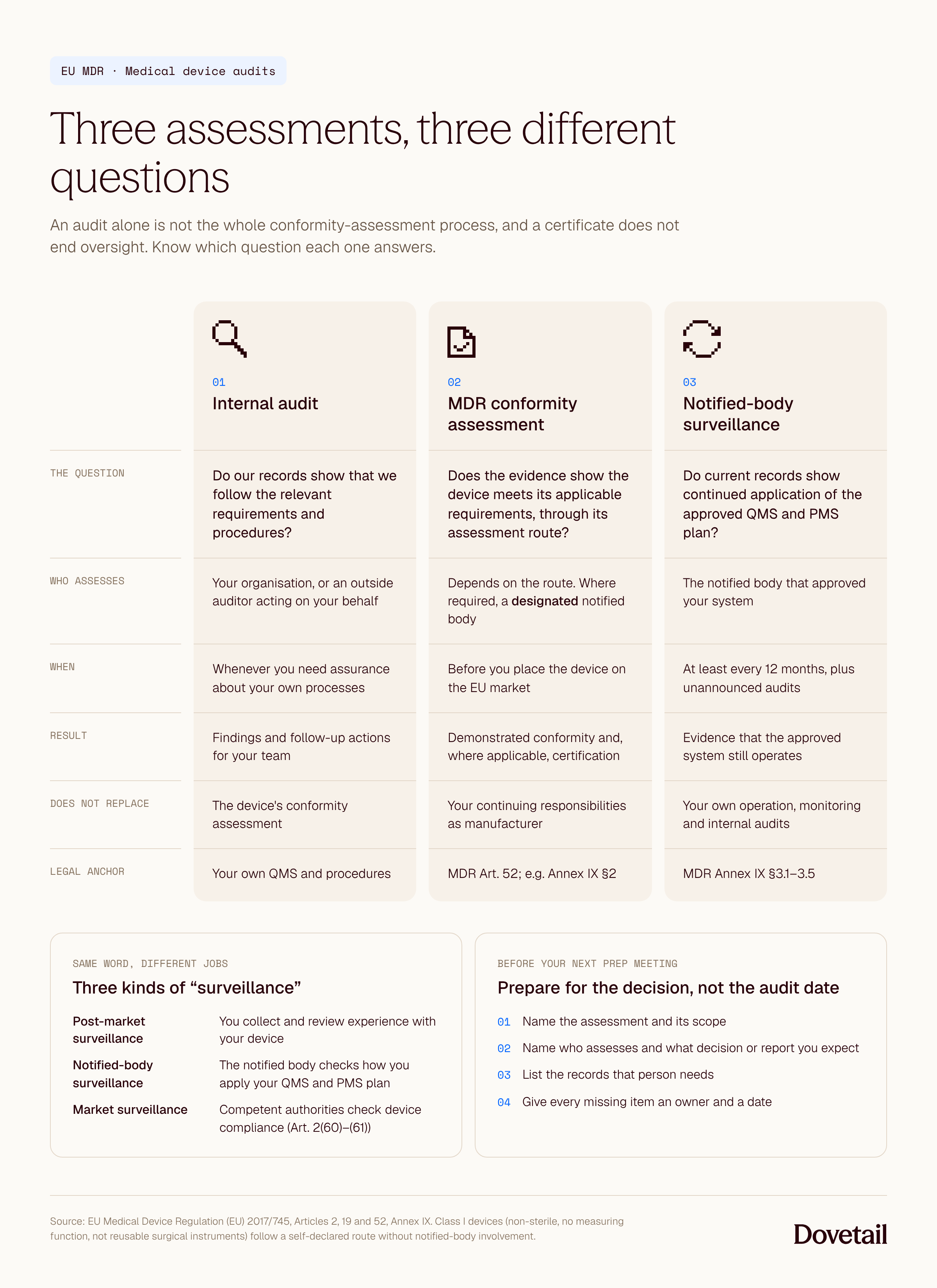
Before you prepare evidence, identify the assessment, what it needs to establish and who will make the decision. The same records can support different checks without making their conclusions interchangeable.
Internal audits help you find gaps in your own work
An internal audit asks whether your organisation follows the requirements and procedures it has committed to. It gives you evidence about how your processes work, rather than relying on the fact that someone wrote them down.
For a founder, that is a useful distinction between having a quality management system and knowing whether people use it. A quality management system, or QMS, sets out how you control work such as design changes, manufacturing and complaints. An internal audit compares records of that work with the relevant criteria, then identifies gaps for follow-up. ISO's explanation of auditing, page 2, describes this evidence-against-criteria approach.
Consider a fictional manufacturer preparing a device for the EU market. Its design-change procedure requires an impact assessment, specified testing and approval before release. An internal auditor selects a completed change and discovers that the team released it before the required approval.
The problem is not a missing procedure. The records show that the team did not follow the procedure. The finding gives the manufacturer something specific to investigate and correct before relying on that process again. Collecting more documents would not, on its own, address the gap.
“Internal” describes whose assurance the audit serves, not whether the auditor receives a salary from your company. You can appoint an outside auditor to act on your behalf, as ISO's terminology explanation makes clear. The auditor still needs the competence and objectivity to assess the work impartially.
The outcome is a set of findings and follow-up actions for your organisation. Even a reassuring internal audit does not establish that you have completed the conformity assessment your device requires. That is a different question with a wider scope.
Conformity assessment demonstrates that your device meets its requirements
Conformity assessment connects your evidence to the requirements that apply to your device. Under the MDR, it is the process of demonstrating whether those requirements have been fulfilled. An audit of your QMS can form part of that process, but the audit visit is not the whole assessment.
This matters when you turn regulatory work into a launch plan. A milestone called “pass the audit” can hide other work, such as preparing the technical documentation that supports the device's safety and performance. An internal report about your processes cannot substitute for that device evidence.
Return to the fictional manufacturer. Correcting its change-approval problem helps it show that its process works. But that finding and correction do not, by themselves, demonstrate that the device meets every applicable requirement. The manufacturer must assemble the evidence for its assessment route, not just the records that answered the internal auditor's question.
For example, the Annex IX route addresses the QMS and, as applicable to the device and route, technical documentation. Its application requirements include device information, the post-market surveillance system for collecting and reviewing experience with the device, and the clinical evaluation plan for assessing clinical safety and performance, among other items. MDR Article 52 and Annex IX section 2.1 set out the route and application requirements.
Where the route requires third-party involvement, a notified body performs the specified assessment activities. A notified body is not simply any organisation that offers audits. It must hold the relevant designation, which you can check through the European Commission's notified-body guidance and register.
Confirm your route before booking an assessment
Not every device needs the same notified-body involvement. This is why classification and route selection belong before a generic audit schedule.
For ordinary Class I devices, excluding custom-made and investigational devices, Article 52(7) provides for the manufacturer to draw up the required technical documentation and issue the EU declaration of conformity. A notified body must participate when the device is sterile, has a measuring function or is a reusable surgical instrument, but its assessment covers only the relevant aspects specified in that article.
For a sterile Class I device, for example, that notified-body scope concerns establishing, securing and maintaining sterile conditions. It is not the same scope as a full assessment of every device characteristic. The manufacturer still has to meet the other applicable MDR requirements.
The manufacturer also retains responsibility when it draws up the EU declaration of conformity. Article 19(3) makes that responsibility explicit. A third-party certificate does not transfer it to the assessor.
Ask what Stage 1 and Stage 2 actually refer to
An ISO 13485 certification schedule can create another source of confusion. ISO 13485 certification concerns the QMS against that standard, whereas MDR conformity assessment concerns the device's applicable regulatory requirements.
In BSI's description of its ISO 13485 certification process, page 2, Stage 1 reviews documentation and readiness. Stage 2 examines implementation through sampling, followed by a recommendation and separate final review. Those labels do not describe two universal stages that complete every MDR route.
If your schedule says “Stage 2 complete”, ask which certification scheme and decision that milestone covers. Then list the device-assessment work that remains. Our guide to planning an MDR conformity assessment timeline helps separate preparation, assessment, responses and the certification decision.
Surveillance checks how the approved system continues to operate
Where your route includes notified-body surveillance, certification begins a continuing oversight relationship. The body needs evidence that you still apply the system it approved, not just a copy of the documents it reviewed earlier.
Under MDR Annex IX, the notified body must carry out appropriate audits and assessments at least once every 12 months to check application of the approved QMS and post-market surveillance plan. This frequency belongs to that route, not to every internal audit or certification scheme. Annex IX also includes unannounced audits, so an annual appointment is not the full extent of surveillance. See Annex IX sections 3.1 to 3.5.
Suppose our fictional manufacturer has since obtained the relevant certification under Annex IX. It has made further design changes and received feedback from users. For surveillance, the original change-control procedure still matters, but so do recent change records, test results, approvals and findings from post-market monitoring. Those records help the body assess how the system operates now.
That changes the preparation task. Rather than rebuilding a folder just before the visit, you need to be able to retrieve evidence of work your organisation has actually performed. Annex IX section 3.2 identifies QMS documentation, post-market findings, relevant design data and manufacturing records among the information the manufacturer must make available.
An internal audit can still help you detect weaknesses in that work. It remains your own assurance activity, while the notified body's surveillance serves the continuing assessment under the applicable route. One does not replace the other.
Your post-market surveillance work supplies evidence for the body's surveillance
The shared word “surveillance” can make two responsibilities sound like one. Post-market surveillance, or PMS, is the manufacturer's systematic collection and review of experience with its devices. Notified-body surveillance can examine how you apply that PMS plan, alongside the approved QMS.
For the fictional manufacturer, collecting and reviewing user feedback is part of its own ongoing work. Showing the resulting records to the notified body is part of the body's oversight. Booking the assessment does not perform the monitoring for you.
Market surveillance is different again. It is the competent authorities' work to check device compliance and protect health, safety and other public interests. The MDR definitions in Article 2(60) and 2(61) distinguish the manufacturer's PMS from those authority activities.
Prepare for the decision, not just the audit date
The three activities can examine overlapping records because good evidence serves more than one purpose. What changes is the question, the assessor's role and the conclusion you can draw.
Activity | The question you are preparing to answer | What the result does not replace |
|---|---|---|
Internal audit | Do our records show that we follow the relevant requirements and procedures? | The device's applicable conformity assessment |
MDR conformity assessment | Does the evidence demonstrate fulfilment of the device's applicable requirements through its assessment route? | The manufacturer's continuing responsibilities |
Notified-body surveillance under Annex IX | Do current records show continued application of the approved QMS and PMS plan? | Your own operation, monitoring and internal assurance work |
Use your next preparation meeting to turn “prepare for audit” into a specific evidence plan.
- Confirm the assessment and its scope, including the applicable market and device route.
- Name the assessor and the report or decision you expect.
- List the records that answer that assessment’s questions.
- Give each missing item an owner and a completion date.
For the fictional manufacturer, the design lead gathers the change record and impact assessment, the testing owner provides the results, and the responsible approver checks the approval history. If the assessment concerns the device's wider conformity, that record set is only one part of the evidence plan. If it concerns ongoing surveillance, the records must show current operation rather than only the original setup.
If you receive findings, preserve the exact requirement and evidence behind each one before preparing the response. Our guide to responding to notified-body findings covers that next step.
You do not need to treat every assessment as a fresh, undefined regulatory project. You do need to know what it establishes and what remains your responsibility afterwards. If that next decision is clear but the evidence plan is not, talk to Dovetail about what needs to be ready.
Sources
- EU Medical Device Regulation, consolidated text of 9 November 2026. Articles 2, 19 and 52 establish the definitions, responsibilities and routes discussed here; Annex IX sets out the QMS assessment and surveillance provisions.
- European Commission guidance on notified bodies. Explains their designated role and links to the official register.
- ISO CASCO explanation of auditing techniques. A 2014 educational resource for audit terminology, not current ISO clause requirements.
- BSI ISO 13485 FAQs. Describes BSI's certification process, including Stage 1 and Stage 2.